

You issue your contractor helper a 1099. Are they included in your payroll?
How workers are classified for policies depends on state laws, not the IRS test most clients rely on. The difference may show up as an unanticipated charge at audit.
Short Version:
Depending on their role, contractors may need to be included in your client’s workers compensation payroll estimate at inception. If it’s left out, the auditor will correct it at the end of the policy period. Contract laborers, even those paid by cash or 1099, are treated like employees for workers comp. If their pay isn’t in the estimate, it will be included at audit, every time. Don’t wait until the premium audit to address these issues.
Long Version:
Who's Actually Covered? A Plain-English Guide to Workers' Comp and Nonemployee Labor
If you run a business, chances are you've brought in help beyond your regular W-2 staff at some point — a contractor to finish a project, a consultant for specialized advice, or a cleaning crew after hours. It's a smart way to stay flexible and control costs. But here's the catch: not all of that "outside help" is treated the same way when it comes to workers' compensation, and getting it wrong can cost you.
Let's break down who's who, and what it means for your policy.
First, What Actually Makes Someone an "Employee"?
For workers' comp purposes, the classic definition of an employee is someone you pay through payroll, report unemployment taxes for, and hand a W-2 to at year's end. Employees get no-fault benefits if they're hurt on the job — meaning it generally doesn't matter who caused the injury, they're covered.
But here's the twist: a W-2 isn't the whole story. Someone who receives a 1099 can still be legally considered an employee in the eyes of a workers' comp board, depending on how much control you exercise over their work and a handful of other factors. In other words, the paperwork you use doesn't always match how the law sees the relationship.
So What Counts as "Nonemployee Labor"?
Nonemployee labor is the umbrella term for anyone who isn't on your payroll and doesn't get a W-2. You'll also hear it called outside labor, nontax labor, or simply "subcontractors." Businesses bring in nonemployee labor for all kinds of reasons — extra hands during busy stretches, specialized skills your team doesn't have, or services that fall outside what your company normally does.
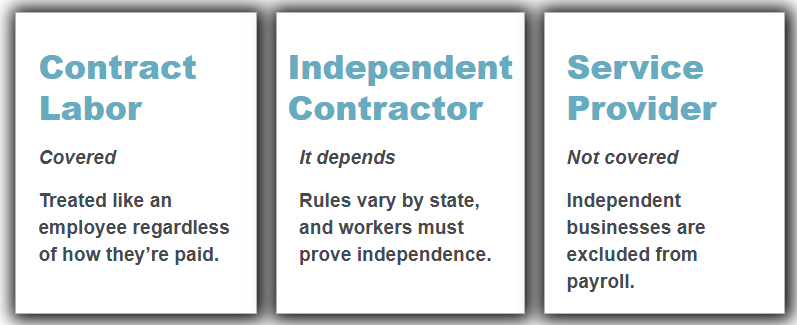
Nonemployee labor generally falls into three buckets:
Contract labor — people working under your direct supervision, just not on your official payroll
Independent contractors — separate businesses that meet your state's independence tests
Service providers — outside firms like accounting or janitorial companies
Each one is treated differently under a workers' comp policy, so it pays to know the difference.
Does Workers' Comp Cover Nonemployees?
Sometimes, yes. Standard workers' comp policies (specifically, Part 5, Section C.2) base your premium on payroll and on "all other remuneration paid or payable for the services of all other persons engaged in work that could make us liable." Translation: some of the money you pay to nonemployee workers still counts toward your premium calculation — and those workers may still be entitled to benefits.
Let's look at each category.
Contract Labor: The Closest Thing to an Employee
Contract laborers work under your direct control — you're telling them what to do, when, and often supplying the tools they use (though sometimes they bring their own). Because you're calling the shots, the law tends to treat them a lot like traditional employees, even if they're paid in cash, via 1099, or by check.
What this means for you: Include their pay in your payroll estimates when your policy starts. Skip this step, and it'll likely get caught — and billed — during your policy audit. If a contract laborer gets hurt on the job, they typically receive the same statutory benefits as your W-2 team. And it doesn't matter whether you pay them hourly, per job, by check, EFT, or cash — none of that changes their coverage status.
Independent Contractors: Truly On Their Own (Usually)
Independent contractors are a different animal. They're generally responsible for carrying their own insurance — but "generally" is doing a lot of work in that sentence, because the rules shift from state to state.
Most states look at some combination of these factors to determine true independence:
Freedom from control — they decide how the work gets done, not you
Outside your usual business — the work isn't part of what your company normally does (this one varies a lot by state)
An independently established trade — they run their own established business
A separate legal entity — ideally an LLC or corporation, not just an individual
Their own billing practices — they invoice you per job rather than collecting a regular paycheck
Their own employees — bonus point toward independence if they have staff of their own
Here's an important myth to bust: the IRS's rules for classifying contractors have nothing to do with workers' comp classification. Just because someone qualifies as a 1099 contractor for tax purposes doesn't mean they'll be treated as independent for workers' comp. Because the criteria differ so much by state, it's worth looping in legal counsel before you assume you're in the clear.
Action steps to protect yourself:
Check your state's independence criteria — not the IRS test.
Get a standard ACORD certificate of insurance showing their policy number, carrier, and coverage dates.
If they can't prove coverage, add their pay to your payroll — because if they're not properly insured, your policy may end up covering them anyway.
If they have their own employees, get proof those workers are covered too. Otherwise, you could be on the hook for them as well.
Service Providers: The Clear-Cut Case
Service providers are the easiest category to sort out. Think accountants, lawyers, cleaning companies, or outside mechanics — established, independent businesses performing work that's clearly outside your normal operations. They're responsible for their own coverage, and you don't need to include their payments in your payroll estimates.
The Bottom Line
Bringing in nonemployee labor can be a great way to scale up without the overhead of full-time hires — but misclassifying that labor is a common (and costly) mistake. Get it wrong, and you could face a surprise premium bump at audit time, or worse, find your policy on the hook for a claim you didn't expect to cover.
The fix is simple in concept, if not always in execution: know the differences between contract labor, independent contractors, and service providers, verify insurance status before work begins, and build a regular review process so nothing slips through the cracks. Your future self — and your premium — will thank you.